
Adaptive Data Rate (ADR)
In this chapter, we will briefly look at the Adaptive Data Rate mechanism used in LoRaWAN networks. Adaptive Data Rate (ADR) allows for easy scaling of a LoRaWAN network, simply by adding gateways and end nodes.
The data rate impacts the device radio power consumption and Time-on-Air (TOA). LoRaWAN features a built-in mechanism for the adaptive management of the end device data rate. The Adaptive Data Rate (ADR) helps to minimize the Time-On-Air (TOA) and to reduce the transmission energy.
The ADR mechanism controls the following transmission parameters of an end device.
- Spreading factor
- Bandwidth
- Transmission power
ADR can optimize the device’s power consumption while ensuring that it is still being received by the gateway. When ADR is in use, the network server will indicate to the end device that it should reduce its transmission power or increase its data rate.
For example, ADR instructs end devices close to a gateway to use a low spreading factor (higher data rate), since they need very little link budget and shorter Time-On-Air to send uplink messages. ADR instructs end devices with low SNR to increase spreading factor (lower data rate) since they need a large link budget and longer Time-On-Air. The higher spreading factors also provide increased processing gain and higher reception sensitivity.
Adaptive Data Rate (ADR) is a simple mechanism that changes the end device’s data rate based on the following rules:
- If the link budget is high, the data rate can be decreased by using a high spreading factor (SF11).
- If the link budget is low, the data rate can be increased by using a low spreading factor (SF7)
Adaptive Data Rate is suitable for devices with particular RF conditions, for example, end devices that do not move. Adaptive Data Rate is not suitable for moving devices, such as animal trackers and vehicle trackers (or any mobile device). For these devices, the Non-Adaptive Data Rate mechanism can be implemented, which transmits messages using a few sets of data rates and uses a predefined pattern to select the next data rate. However, mobile end devices can also temporarily enable ADR if they will remain stationary for a long time.
An end device will decide when to use ADR (although the network server can also force the device's MAC layer to set or unset the ADR bit). The end device requests that the network server control its transmission parameters by setting the ADR flag in an uplink frame header. The network server collects the 20 most recent uplink transmissions for the device, averages the Signal-to-Noise Ratio (SNR) values, and then determines how much margin there is.
The following table presents SNR and demodulation margin for each data rate.
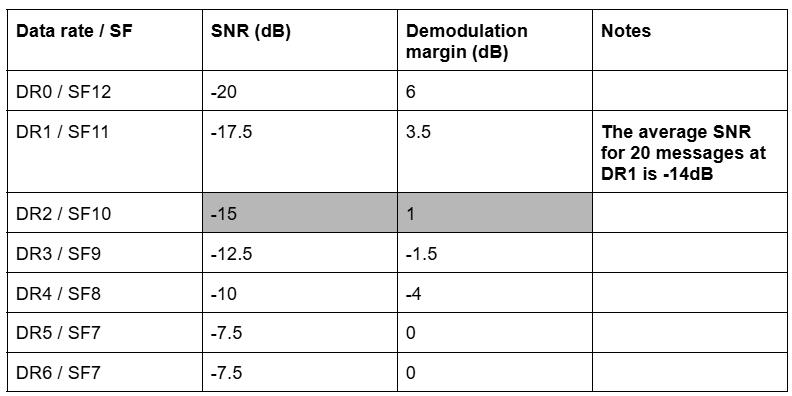
For example, if the calculated average SNR for 20 uplink messages with DR1 is -14dB, the results best fit for DR2 because the SNR of DR2 is -15dB and its demodulation margin is 1 dB. So we have enough margin for demodulating the signal with DR2.
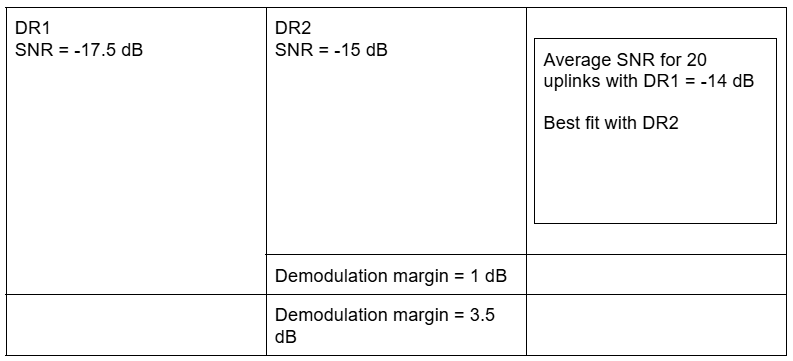
The network server would then schedule a downlink with a MAC command for the end device to increase its data rate to DR2.