
NB-IoT Network Architecture
Introduction
NB-IoT (Narrowband Internet of Things) builds upon the existing LTE network structure, but it is simplified and optimized for low data rates, massive device connections, and long battery life.
While it shares the same fundamental components as LTE, the User Equipment (UE), the Radio Access Network (RAN), and the Core Network (CN). NB-IoT adapts these components to meet the needs of IoT applications.
At a high level, the NB-IoT network can be visualized as:
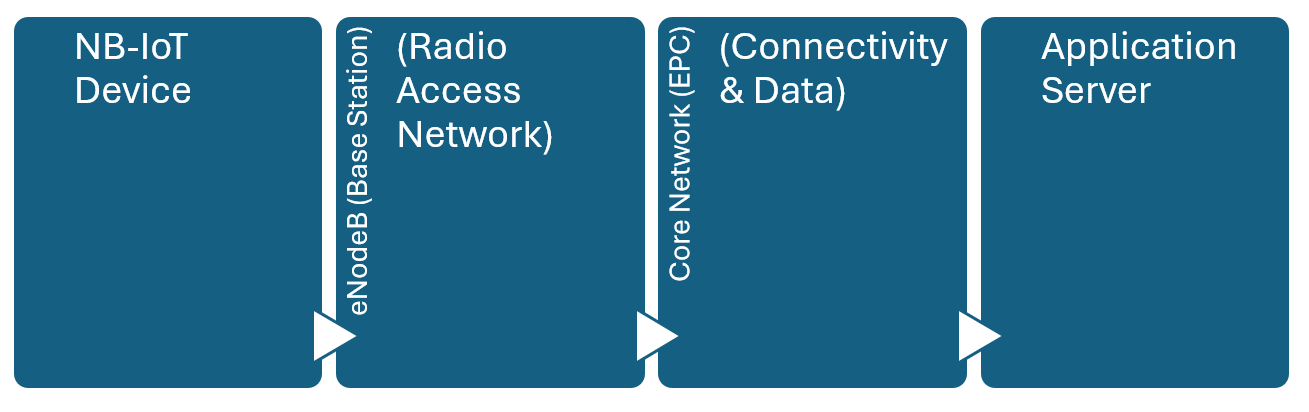
Main Components
User Equipment (UE)
The UE is the end device, for example, a smart meter, temperature sensor, or tracking module. It includes:
- An NB-IoT modem (radio module)
- A SIM or eSIM for network authentication
- Application firmware controlling data collection and transmission
NB-IoT devices are typically low-cost, low-power, and stationary. They transmit small packets of data periodically or on demand.
eNodeB (Evolved Node B)
The eNodeB is the NB-IoT base station — the point where the device connects to the network via radio signals.
It handles:
- Uplink and downlink scheduling
- Power control and repetitions for improved coverage
- Resource allocation in narrow 180 kHz channels
- Mobility management (for limited mobility devices)
NB-IoT can be deployed in three ways relative to LTE:
- In-band – within an LTE carrier’s bandwidth
- Guard-band – in unused guard bands between LTE channels
- Standalone – on re-farmed GSM carriers
This flexibility allows mobile operators to roll out NB-IoT using existing infrastructure.
EPC (Evolved Packet Core)
The Evolved Packet Core (EPC) is the core part of the LTE system responsible for control, mobility, and data transport. In NB-IoT, the EPC is slightly simplified, as devices are usually static and transmit infrequently.
| Component | Function |
|---|---|
| MME (Mobility Management Entity) | Handles device registration, authentication, and idle/connected state management. |
| SGW (Serving Gateway) | Routes user data between eNodeB and the core network. |
| PGW (Packet Gateway) | Connects to the external IP network or the Internet. |
| HSS (Home Subscriber Server) | Stores subscriber information and SIM authentication data. |
NB-IoT may use both User Plane and Control Plane data transmission:
- User Plane: standard IP-based communication via PGW.
- Control Plane (Non-IP): small payloads embedded within NAS messages, ideal for power saving and reduced signaling.
Application Server
The Application Server is the destination for the device’s sensor data and the source of control commands.
It communicates with the network via:
- IP-based interfaces (for UDP/TCP applications), or
- Non-IP interfaces (for control-plane data delivery)
Data can be integrated into cloud platforms, IoT dashboards, or SCADA systems.
Communication Flow
A simplified view of an NB-IoT message flow:
- Attach – The device connects to the network and authenticates using SIM credentials.
- Bearer Setup – A communication path (bearer) is created between the device and the network.
- Data Transmission – The device sends small packets of data (uplink) and optionally receives downlink data.
- Release – The network releases the radio connection; the device may enter Idle or PSM mode.
- Periodic TAU – The device periodically updates its location information to stay registered.
NB-IoT communication is half-duplex, meaning it cannot transmit and receive simultaneously, which helps reduce complexity and cost.
Control Plane vs User Plane Data Delivery
NB-IoT supports two different methods of transferring data:
| Data Type | Description | Typical Use |
|---|---|---|
| Control Plane (Non-IP Data Delivery) | Small payloads are embedded directly into signaling messages. | Sensors sending a few bytes periodically. |
| User Plane (IP Data Delivery) | Standard IP connection is established for data transfer. | Devices needing standard Internet protocols (e.g., MQTT, HTTP). |
The control plane method uses less signaling overhead and conserves power, making it the preferred choice for many low-data-rate applications.
Deployment Flexibility
NB-IoT leverages the LTE architecture, so operators can deploy it without building new physical networks.
| Deployment Mode | Spectrum Use | Advantage |
|---|---|---|
| In-band | Inside LTE carrier | Easy deployment, spectrum reuse |
| Guard-band | LTE guard frequencies | No additional spectrum needed |
| Standalone | Re-farmed GSM band | Ideal for rural or dedicated IoT coverage |
This multi-mode approach makes NB-IoT highly scalable and globally deployable.
Summary
NB-IoT reuses the LTE core network and radio access principles but is tailored for:
- Massive device connectivity
- Deep indoor coverage
- Low throughput
- Long battery life
The architecture’s simplicity and reliance on proven LTE infrastructure make it one of the most efficient and cost-effective technologies for large-scale IoT deployments.